
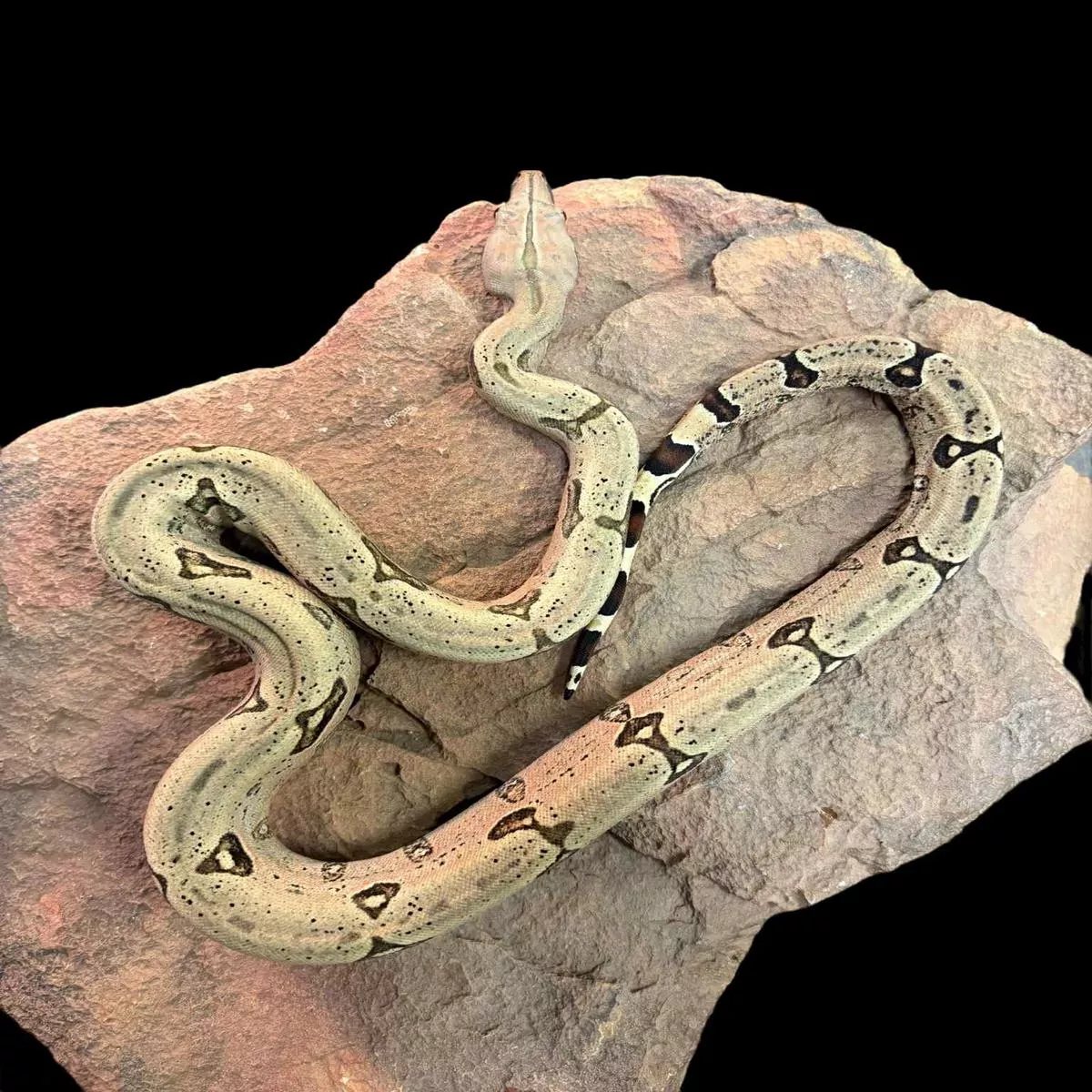
Bolivian Boa (Patternless)
Scientific Name: Boa constrictor amaraliCommon Name: Bolivian Boa, Patternless
Species Overview
Size: Adults typically reach 57 feet (1.52.1 m) in length, with females slightly larger than males. Adult weight ranges from 1525 pounds, reflecting a compact and muscular build.
Appearance: This Bolivian Boa exhibits a patternless or very reduced pattern expression, resulting in a uniform coloration that is usually dark brown to chocolate with minimal contrast. The body is stocky and muscular, characteristic of the subspecies.
Distribution: Native to central Bolivia, usually near forests, scrublands, and river systems.
Habitat: Inhabits tropical and subtropical forests, semi-arid regions, and riverine environments. Adapted to seasonal fluctuations in humidity.
Behaviour: Primarily nocturnal ambush predators. Juveniles may climb low vegetation, while adults remain largely terrestrial. Generally calm but physically strong.
Captive Care
Enclosure: A naturalistic setup is recommended. Adults should have a minimum enclosure of 422 (1226161 cm), though larger individuals benefit from 5622 setups. Include multiple hides, sturdy branches, water dish, and visual barriers. Soil or mulch substrates support humidity and natural behaviours.
Temperature and Humidity: Maintain ambient temperatures of 7882F (2628C), with a basking spot of 8890F (3132C). Nighttime temperatures may drop to 7276F (2224C). Humidity should remain between 5570%, supported by a water dish for soaking.
Lighting: Standard ambient lighting on a consistent daynight cycle is sufficient. Low-output UVB is optional for planted or bioactive enclosures.
Diet: Juveniles feed every 710 days on appropriately sized rodents; adults feed every 1421 days.
Behaviour in Captivity: Hardy and adaptable, with a generally calm temperament. Assisted handling is recommended for larger adults due to their muscular strength.
Special Considerations: The compact, muscular body and potential adult size require careful long-term housing planning. Assisted handling is strongly recommended.
Taxonomy Note
Boa constrictor amarali, the Bolivian Boa, is a distinct subspecies of Boa constrictor endemic to central Bolivia. It is characterised by a stocky, muscular build, darker earthy coloration, and a tendency for reduced or uniform patterning in some individuals. Wild populations occupy forests, scrublands, and riverine habitats, showing adaptability to both humid and semi-arid conditions. In captivity, Bolivian Boas retain the typical calm temperament, ambush predation behaviours, and adaptability of Boa constrictor, making them manageable with consistent care.
Genetics Note
Patternless (Line-Bred / Polygenic Trait): The Patternless trait in Bolivian Boas is achieved through selective breeding for reduced dorsal and lateral patterning. While snakes marketed as Patternless show greatly diminished markings, they may still retain minor traces of the original pattern. This is not a formally documented single-gene recessive; rather, it is influenced by multiple alleles and selective line-breeding. Offspring may vary in pattern depending on the parents genetic contributions and lineage.



 No products in the cart.