Emerald Tree Boa (Guyana Form)
Corallus caninusCommon Name: Guyana Emerald Tree Boa
Species Overview
-
Size: Adults typically reach 57 feet (1.52.1 m), with females usually larger and more robust than males.
-
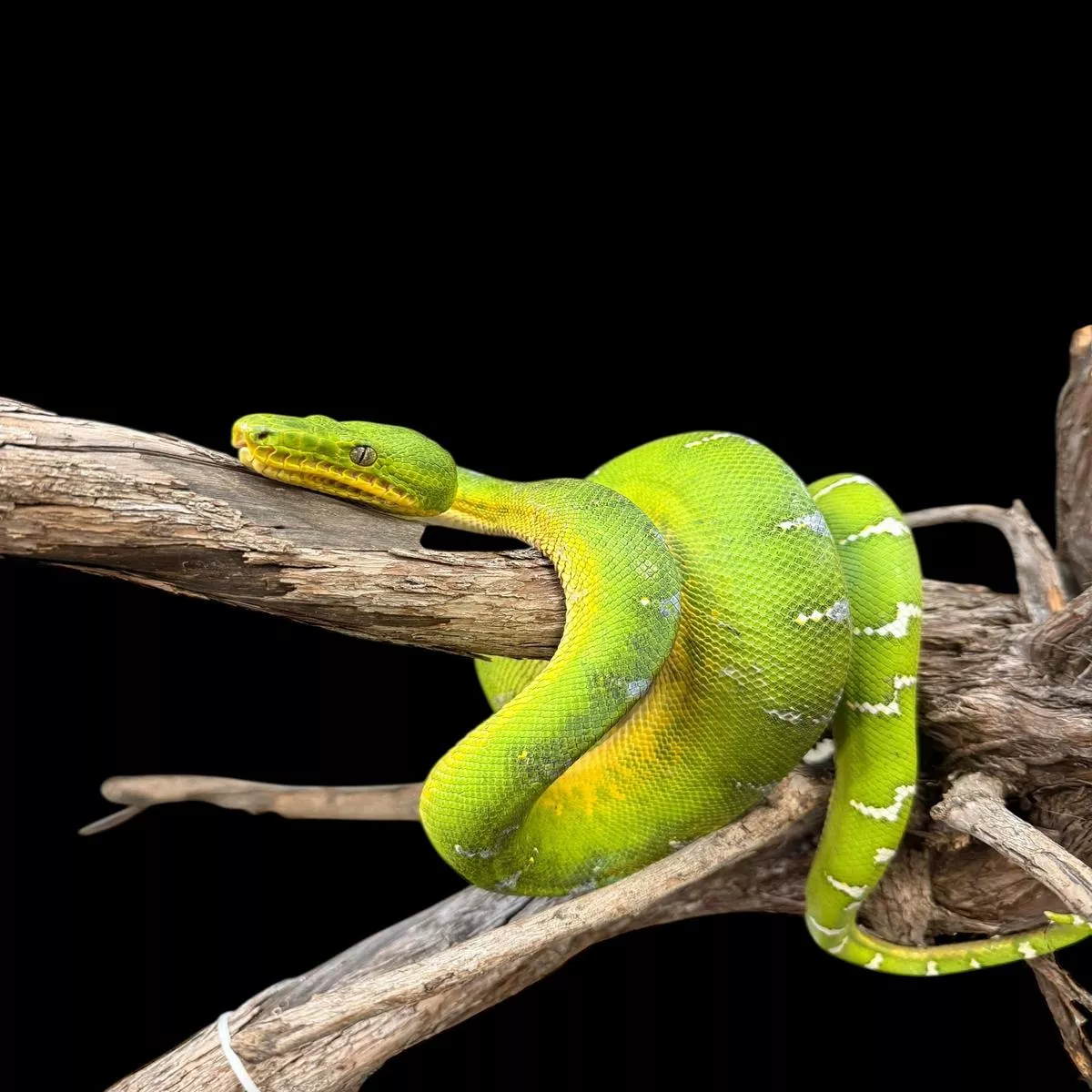
Appearance: Guyana emerald tree boas are typically bright emerald-green with irregular white or yellow vertebral markings along the back. Unlike Basin emerald tree boas, their dorsal markings are usually broken or patchy rather than continuous, giving them a more scattered pattern. Their build is also slimmer and more gracile compared to the stocky Basin form.
-
Distribution: Found in Guyana and surrounding regions of northeastern South America.
-
Habitat: Arboreal, inhabiting humid lowland forests, swamp margins, and dense jungle canopies.
-
Behaviour: Ambush predators that coil on branches in the classic emerald boa posture, striking at passing prey. They feed primarily on birds, small mammals, and reptiles. Mostly nocturnal.
Captive Care
-
Enclosure: Provide a vertically oriented enclosure with sturdy horizontal perches. A 34 tall enclosure with at least 42 floor space is suitable for adults. Include cork bark, foliage, and climbing branches.
-
Temperature & Humidity: Maintain daytime temperatures of 7882F (2528C) with a mild basking zone around 8586F (2930C). Night drops to 7476F (2324C) are beneficial. Humidity should remain 7090%, with regular misting and strong ventilation to prevent stagnant, damp conditions.
-
Diet: Juveniles should be fed appropriately sized rodents every 1014 days; adults every 2128 days. While wild individuals may consume birds, rodents are standard in captivity.
-
Behaviour in Captivity: Guyana emerald tree boas are often more defensive than Basin forms, relying on striking when disturbed. They are best maintained as display animals, with handling kept to a minimum.
-
Special Considerations: Sensitive to poor environmental balanceparticularly humidity and airflow. Incorrect conditions can quickly lead to respiratory or skin issues.
Locality Note
The Guyana emerald tree boa represents the northern form of Corallus caninus. Compared to the Amazon Basin form, they are generally smaller, slimmer, and display broken dorsal markings instead of a solid white stripe. Their striking colouration and more affordable availability make them popular, though they are often considered less docile and more defensive than Basin emeralds.