
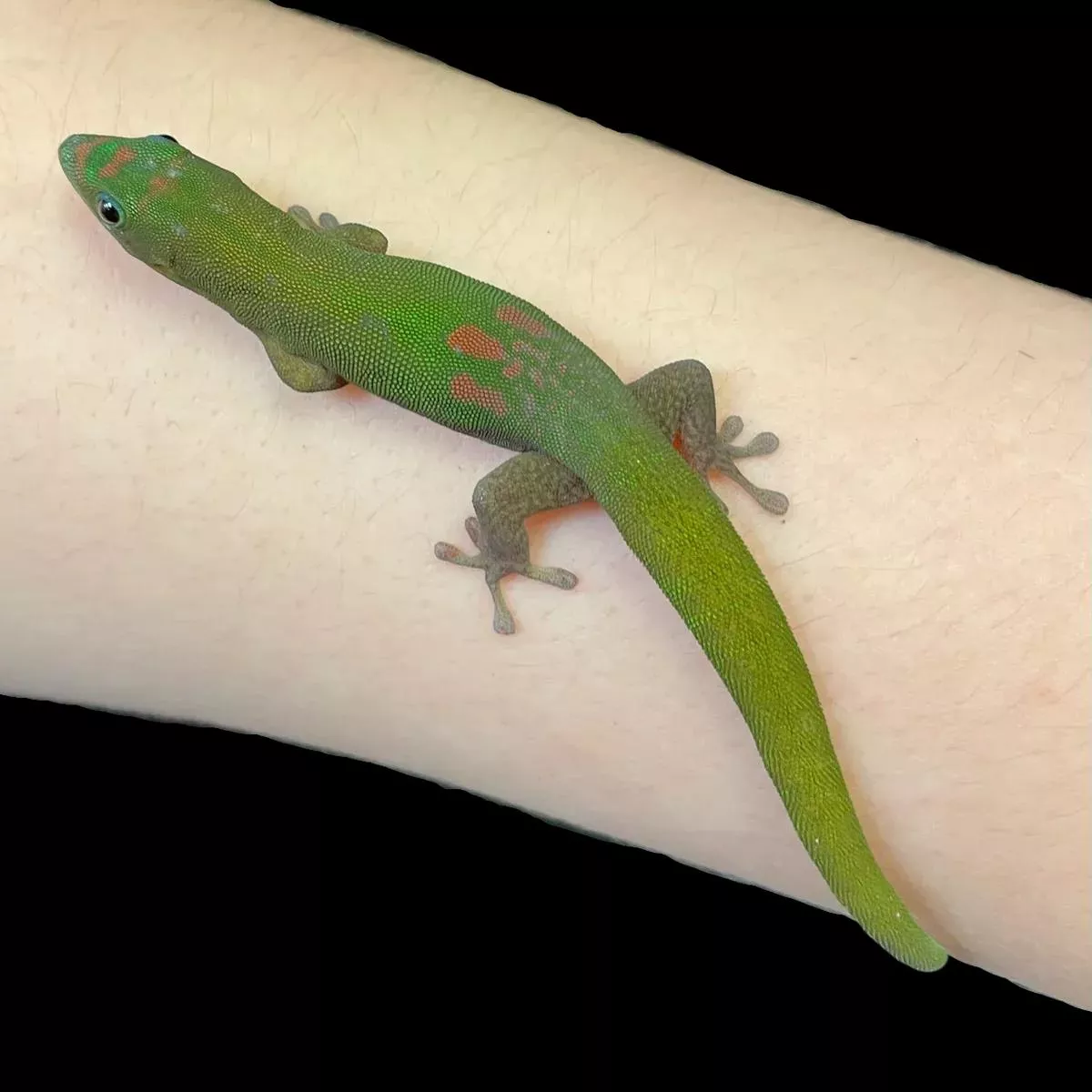
Gold Dust Day Gecko
Scientific Name: Phelsuma laticaudaCommon Name: Gold Dust Day Gecko
Species Overview
Size: Adult Gold Dust Day Geckos typically reach 56 inches (1315 cm) in total length, including the tail. They are slender, bright green geckos with smooth skin and a lightly flattened body adapted for arboreal life.
Appearance: This species is one of the most colourful and recognizable geckos in the Phelsuma genus. The body is a vibrant emerald to lime green, speckled with fine golden dusting across the head, neck, and back. Three red or orange markings appear on the lower back and snout, while the underside is pale cream to yellow. The large eyes are bright turquoise with round pupilsunusual for geckos, as they are diurnal and rely on keen daytime vision. The toes have wide, adhesive pads, allowing them to climb smooth glass and leaves with ease.
Distribution: Native to Madagascar and nearby islands, including the Comoros, Seychelles, and Mauritius. The species has also established introduced populations in Hawaii and parts of Florida.
Habitat: In the wild, Gold Dust Day Geckos inhabit tropical forests, coastal vegetation, and even urban gardens. They prefer warm, humid environments with abundant foliage and vertical surfaces. In captivity, they thrive in tall, plant-filled enclosures that replicate these lush, sunlit habitats.
Behaviour: These geckos are diurnal (active during the day), alert, and quick-moving. They are territorialespecially malesand should not be housed together unless part of a monitored breeding pair. Despite their delicate appearance, they are hardy when provided with proper conditions.
Captive Care
Enclosure: Provide a vertically oriented enclosure measuring at least 18 inches18 inches24 inches (454560 cm) for a single adult. A heavily planted terrarium with live plants such as bromeliads, pothos, and philodendron encourages natural climbing and hiding behaviour. Include cork bark, bamboo, and vines for basking and security.
Temperature & Humidity: Maintain daytime ambient temperatures between 7886F (2530C) with a basking area around 88F (31C). Nighttime temperatures can drop to 7074F (2123C). Keep humidity between 6080%, achieved through regular misting and live vegetation. Provide good airflow to prevent mould and stagnant moisture.
Lighting: Provide full-spectrum UVB lighting (57%) on a 12-hour day/night cycle. As a diurnal species, Phelsuma laticauda relies on strong UVB and visible light exposure for activity, feeding, and calcium metabolism.
Diet: Offer a mix of live insects such as crickets, small roaches, and fruit flies, along with commercial Phelsuma-specific fruit-nectar diets. Dust insects with calcium and multivitamin supplements. Adults can also be offered small amounts of mashed tropical fruit like mango or papaya. Feed juveniles daily and adults 34 times per week.
Behaviour in Captivity: Gold Dust Day Geckos are lively, curious, and visually engaging display animals. They are best kept as hands-off pets due to their delicate skin and speed but are highly interactive within their enclosure. With stable environmental conditions, they adapt well and live 1015 years in captivity.
Special Considerations: Avoid handling, as their skin can tear easily. Misting should be light and frequent to maintain humidity without waterlogging the enclosure. Provide UVB lighting and a varied diet for optimal colour and health.
Taxonomy Note
The Gold Dust Day Gecko (Phelsuma laticauda) belongs to the family Gekkonidae and is one of over 40 species within the genus Phelsuma. This genus is entirely diurnal, with members known for their vivid coloration, smooth skin, and adhesive toe pads. P. laticauda is closely related to the Peacock Day Gecko (Phelsuma quadriocellata) but is smaller and more uniformly coloured.
Genetics Note
There are currently no formally recognized morphs of Phelsuma laticauda; however, two subspecies are recognized:
-
Phelsuma laticauda laticaudathe nominate form, displaying vibrant green and gold with bold red markings.
-
Phelsuma laticauda angularistypically lighter in colour, with narrower body proportions and subtler markings.
Selective breeding has produced slight variations in colour intensity, but all remain naturally patterned, maintaining the wild-type appearance prized among keepers.






 No products in the cart.