
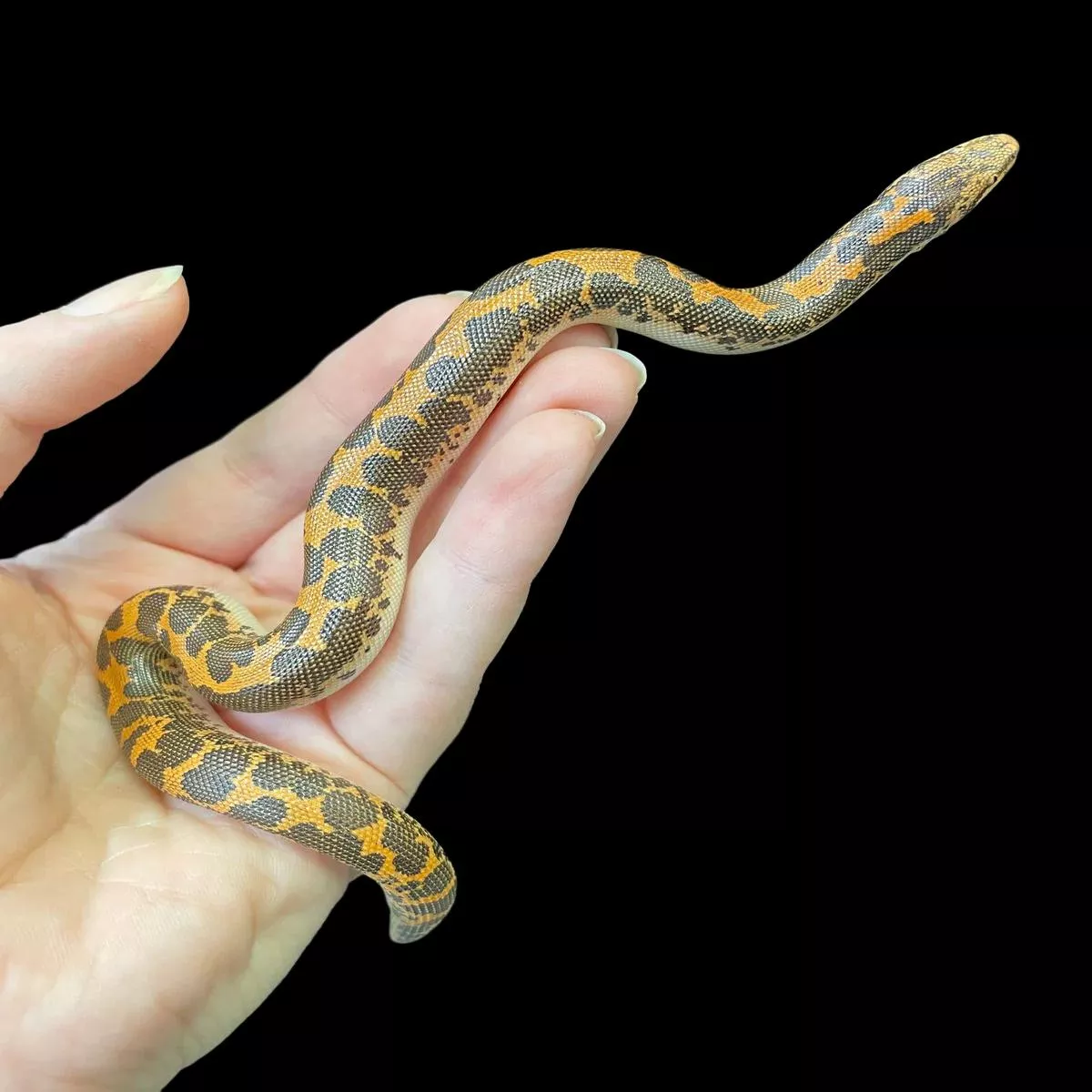
Kenyan Sand Boa (Het Anery)
Eryx colubrinusCommon Names: Kenyan Sand Boa, East African Sand Boa
Species Overview
-
Size: Adults typically grow to 1830 inches (4575 cm), with females larger and bulkier than males.
-
Appearance: Visually resembles the normal/wild-type Kenyan Sand Boa, with orange to yellow saddles on a dark brown background. As a het (heterozygous) animal, it does not display the Anerythristic morph visually but carries the gene.
-
Distribution: Native to East Africa, particularly Kenya, Ethiopia, and Sudan.
-
Habitat: Inhabits arid savannahs, deserts, and scrubland, preferring loose sandy soil and rocky areas for burrowing.
-
Behaviour: A fossorial ambush predator, spending most of its time buried under the substrate, waiting to strike at prey such as small mammals, birds, and lizards.
Captive Care
-
Enclosure: A 20-gallon long tank or equivalent suits most adults. Provide deep, loose substrate such as sand, aspen, or soil/sand mix for burrowing. Include a shallow water dish and at least one secure hide.
-
Temperature & Humidity: Maintain a gradient of 7882F (2528C) with a basking spot of 9095F (3235C). Night drops to 7275F (2224C) are fine. Humidity should remain 3050%, reflecting their arid native habitat.
-
Diet: Juveniles should be fed pinky mice every 57 days; adults every 1014 days on small rodents. Monitor body condition, as sand boas are prone to obesity.
-
Behaviour in Captivity: Known to be docile, slow-moving, and secretive. They tolerate handling well but will spend much of their time buried.
-
Special Considerations: A deep substrate is essential to support their natural burrowing behaviour.
Genetics Note
-
Anerythristic (Recessive): Removes red and orange pigments, producing gray/black coloration when expressed.
-
Het Anery: This snake carries one copy of the recessive gene but does not visually display the morph.
-
Husbandry and care remain identical to wild-type Kenyan Sand Boas.



 No products in the cart.