
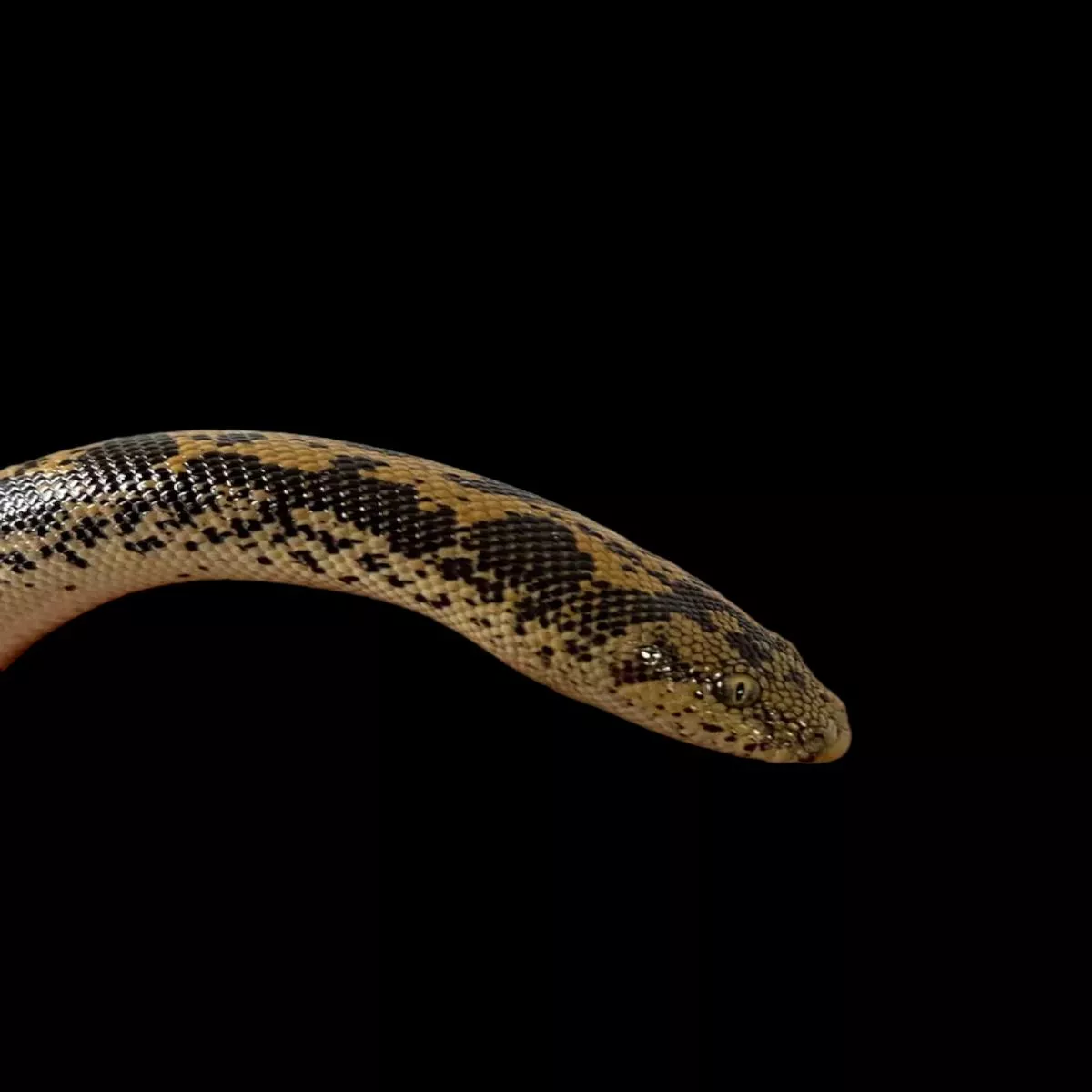
Kenyan Sand Boa (Normal)
Eryx colubrinusCommon Names: Kenyan Sand Boa, East African Sand Boa
Species Overview
-
Size: Adults reach 1830 inches (4575 cm) on average, with females significantly larger and bulkier than males.
-
Appearance: Wild-type Kenyan Sand Boas display bright orange or yellow saddles over a dark brown to black background. Their stout, cylindrical body, short tail, and wedge-shaped head are all well-adapted for burrowing.
-
Distribution: Found throughout East Africa, including Kenya, Ethiopia, Tanzania, and Sudan.
-
Habitat: Inhabits arid savannahs, deserts, and scrublands, where it spends most of its life beneath loose sandy soil.
-
Behaviour: A fossorial ambush predator, lying buried with only the head exposed, striking quickly at passing prey such as rodents, birds, or reptiles.
Captive Care
-
Enclosure: A 20-gallon long tank (or equivalent) is suitable for most adults. Provide deep, loose substrate such as sand, aspen, or a soil/sand mix for burrowing. Include at least one hide and a shallow water dish.
-
Temperature & Humidity: Maintain a warm side of 9095F (3235C) with a cooler side around 7882F (2528C). Nighttime temps can safely drop to 7275F (2224C). Humidity should remain low, around 3050%, to mimic their native habitat.
-
Diet: Juveniles should be fed pinky mice every 57 days. Adults thrive on small rodents every 1014 days. Sand boas can be prone to obesity, so careful portion control is important.
-
Behaviour in Captivity: Kenyan Sand Boas are docile, secretive, and easy to handle. They spend much of their time buried and surface primarily for feeding.
-
Special Considerations: Provide deep substrate to allow burrowing and reduce stress.
Genetics Note
The Normal, or wild-type, Kenyan Sand Boa does not carry or express any selectively bred morph traits. It serves as the foundation stock for many morph projects (Albino, Anery, Snow, Paradox, etc.), with husbandry remaining identical across all forms.



 No products in the cart.