
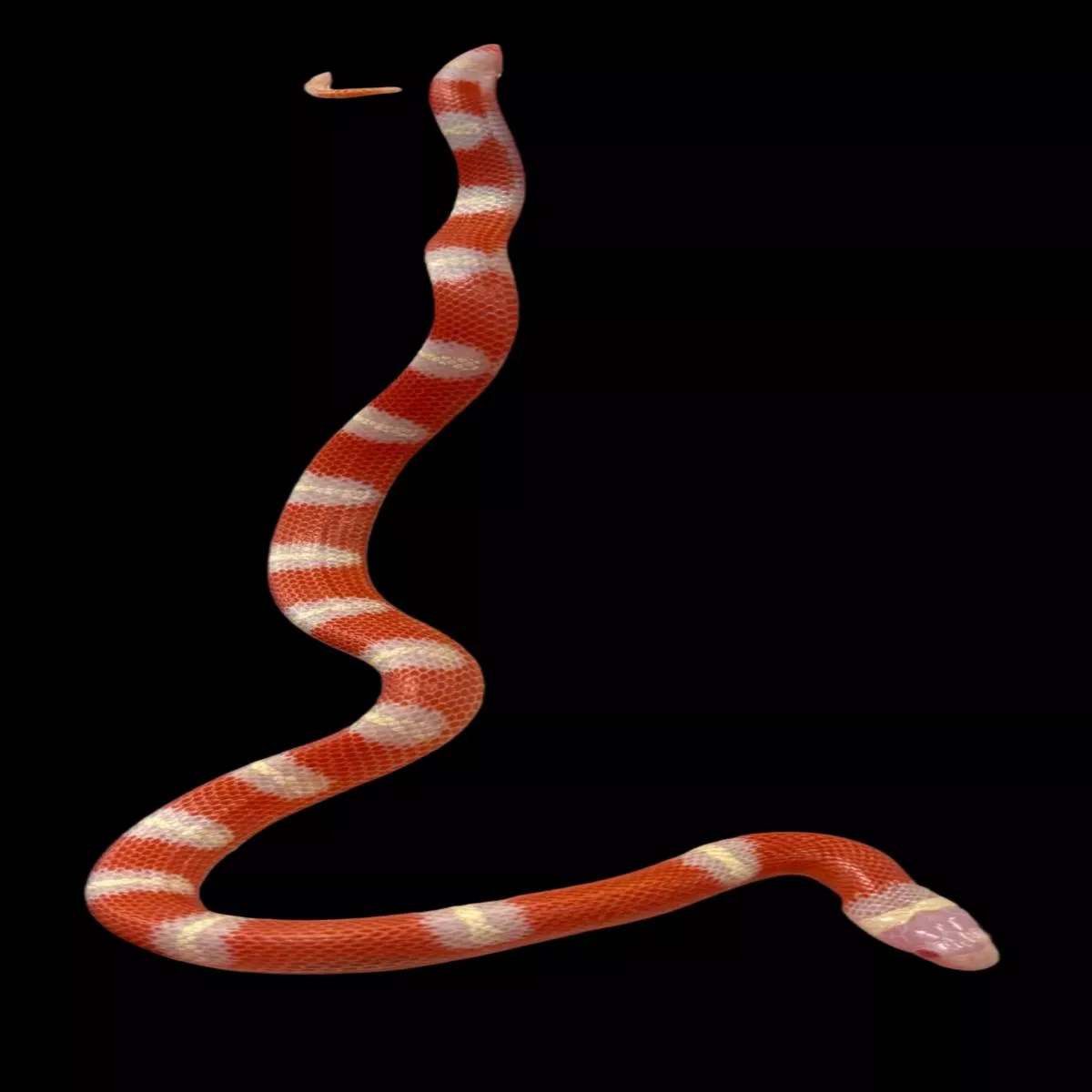
Nelsons Milksnake (T Albino)
Scientific Name: Lampropeltis triangulum nelsoniCommon Name: Nelsons Milksnake
Species Overview
Size: Adults typically reach 34.5 feet (0.91.4 m) in length, with a slender, agile build and smooth, glossy scales.
Appearance: The T Albino Nelsons Milksnake is a beautifully warm-toned morph known for its soft, translucent colours and reduced contrast. The T Albino gene removes most black pigment while allowing a small amount of melanin to remain, producing rich pink, orange, and light brown hues rather than stark whites and yellows. The result is a creamy pastel palette where red banding shifts toward coral or peach, and black rings become bronze or golden tan. This subtle balance of pigment gives the morph a glowing, almost iridescent appearance under natural light. The eyes are light brown to reddish, harmonizing with the overall warmth of the snakes colouration.
Distribution: Originates from selective captive breeding of Nelsons Milksnakes, a subspecies native to western and central Mexico.
Habitat: Nelsons Milksnakes inhabit dry tropical forests, scrublands, and agricultural areas in Mexico. In captivity, this morph thrives in naturalistic terrariums with soft substrate, climbing branches, and secure hiding areas.
Behaviour: Nelsons Milksnakes are confident, calm, and hardy. They tolerate handling well once acclimated and are known for their strong feeding response and adaptability to varied environments.
Captive Care
Enclosure: Provide an enclosure at least 34 feet in length for adults, with multiple hides, smooth dcor, and climbing branches. A naturalistic substrate such as soil, coconut fibre, or aspen allows burrowing and helps regulate humidity.
Temperature & Humidity: Maintain a daytime gradient of 7885F (2529C) with a basking area near 8890F (3132C). Allow nighttime drops to around 70F (21C). Maintain humidity between 5065%, providing a humid hide during shedding.
Diet: Offer frozen-thawed rodents every 710 days for juveniles and every 1014 days for adults. Nelsons Milksnakes are enthusiastic feeders and readily accept a consistent feeding routine.
Behaviour in Captivity: Active and alert yet easy to handle, these snakes thrive under stable care. Their warm coloration and calm demeanor make them popular among both display keepers and breeders.
Special Considerations: Milksnakes should always be housed individually, as they may prey on other snakes.
Genetics Note
T Albino (Recessive): A recessive trait that removes most black pigment while retaining partial melanin expression. This allows for warm pinks, peaches, and light browns rather than pure white and yellow tones. The T designation refers to Tyrosinase-Positive, meaning the enzyme responsible for limited melanin production is still active in small amounts.
Comparison: The T Albino differs from standard Albino (T) forms, which completely remove melanin and create higher-contrast, white-and-red snakes. The T version yields more natural, softly blended hues.
Genetic Combination Summary
The Nelsons Milksnake (T Albino) expresses a single recessive trait:
-
T Albino (Recessive): Reduces black pigment but allows faint melanin expression, resulting in a warm, pastel coloration.
This morph produces a soft, natural glow of colour unique among albino variations. The T Albino Nelsons Milksnake is valued for its balanced palette and genetic distinction, offering both aesthetic appeal and a solid foundation for selective breeding or display.










 No products in the cart.