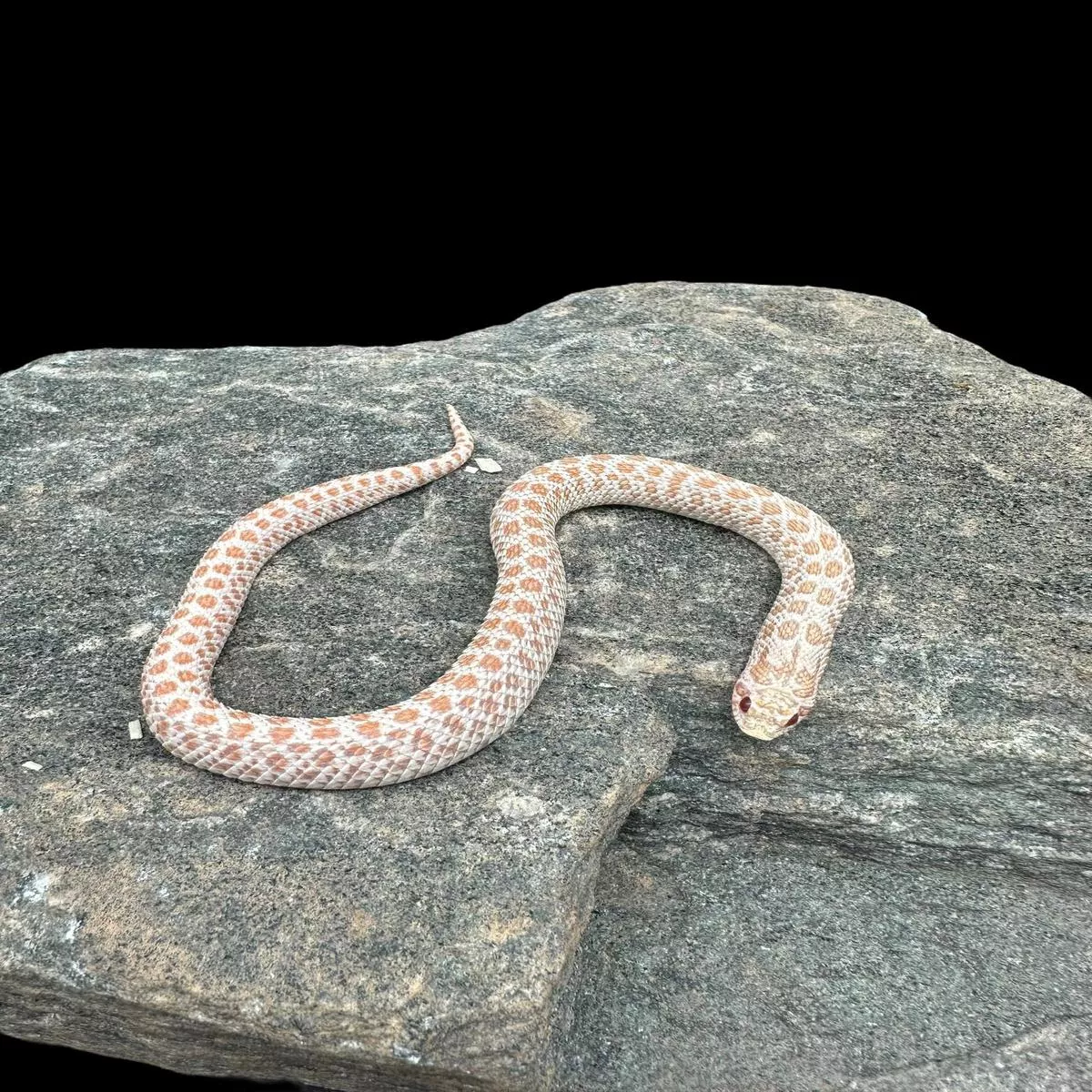
Western Hognose (Albino Super Arctic)
Scientific Name: Heterodon nasicusCommon Name: Western Hognose Snake
Species Overview
Size: Adult females typically reach 23 feet (0.60.9 m) in length, while males remain smaller, averaging 1.52 feet (0.450.6 m). Both sexes share the species characteristic upturned snout, used for burrowing and uncovering prey in loose soil.
Appearance: The Albino Super Arctic Western Hognose is a highly distinctive and visually refined morph that combines the Albino genes bright coloration with the extreme pattern contrast of the Super Arctic trait. The Albino gene removes dark pigment, revealing golden yellows, oranges, and creams, while the Super Arctic traitbeing the homozygous form of Arcticcreates a sharply defined pattern with lighter saddles and near-white borders. The resulting snake is a stunning mix of soft gold and bright cream tones arranged in a crisp, clean pattern. The red eyes, inherited from the Albino gene, further accentuate the warm tones, producing an elegant and balanced visual effect.
Distribution: Native to central North America, ranging from southern Canada through the central United States and into northern Mexico.
Habitat: Western Hognose Snakes inhabit prairies, open scrublands, and sandy plains where they burrow beneath loose, dry soil. In captivity, this morph thrives in terrestrial terrariums with soft substrate, climbing dcor, and secure hiding areas.
Behaviour: Western Hognoses are active and diurnal, displaying confident and inquisitive personalities. When startled, they may flatten their necks or hiss as a bluff display but are harmless and settle quickly with gentle handling.
Captive Care
Enclosure: Provide an enclosure at least 3 feet18 inches18 inches for adults. Use soft, loose substrate such as aspen or a sand-soil blend for burrowing. Include multiple hides, smooth dcor, and low branches for exploration.
Temperature & Humidity: Maintain a daytime gradient of 7886F (2530C) with a basking area near 90F (32C). Allow nighttime drops to 7074F (2123C). Keep humidity between 3050%, increasing slightly during shedding periods.
Diet: Offer thawed rodents approximately 1.25 the width of the snakes mid-body. Feed juveniles every 45 days and adults every 710 days. Western Hognoses are reliable feeders with strong feeding responses.
Behaviour in Captivity: These snakes are hardy and engaging, adapting well to consistent care routines. They are active during the day and often display curious, exploratory behaviour, making them both entertaining and rewarding to keep.
Special Considerations: Western Hognoses are mildly rear-fanged, and their venom poses minimal risk to humans unless an allergic reaction occurs. They should always be handled calmly and housed individually to prevent stress or feeding aggression.
Genetics Note
Albino (Recessive): Removes black pigmentation, replacing it with warm yellow, orange, and cream tones. The red eyes add a distinctive brightness and contrast.
Super Arctic (Incomplete DominantHomozygous Form): The homozygous expression of the Arctic gene produces extreme pattern refinement, high contrast, and enhanced brightness of light scales. When combined with colour-altering traits like Albino, the result is a clean, vivid, pastel-toned snake.
Genetic Combination Summary
The Western Hognose (Albino Super Arctic) expresses two visual genetic traits:
-
Albino (Recessive): Eliminates black pigment, producing soft yellows, oranges, and creams with red eyes.
-
Super Arctic (Incomplete Dominant Homozygous): Sharpens pattern contrast and brightens overall coloration, creating an exceptionally clean, crisp look.
Together, these traits produce one of the most visually refined Western Hognose combinationsa smooth, high-contrast pastel snake with exceptional clarity and appeal. The Albino Super Arctic is highly valued among breeders for its balance of brightness, pattern definition, and potential for producing visually striking future pairings.