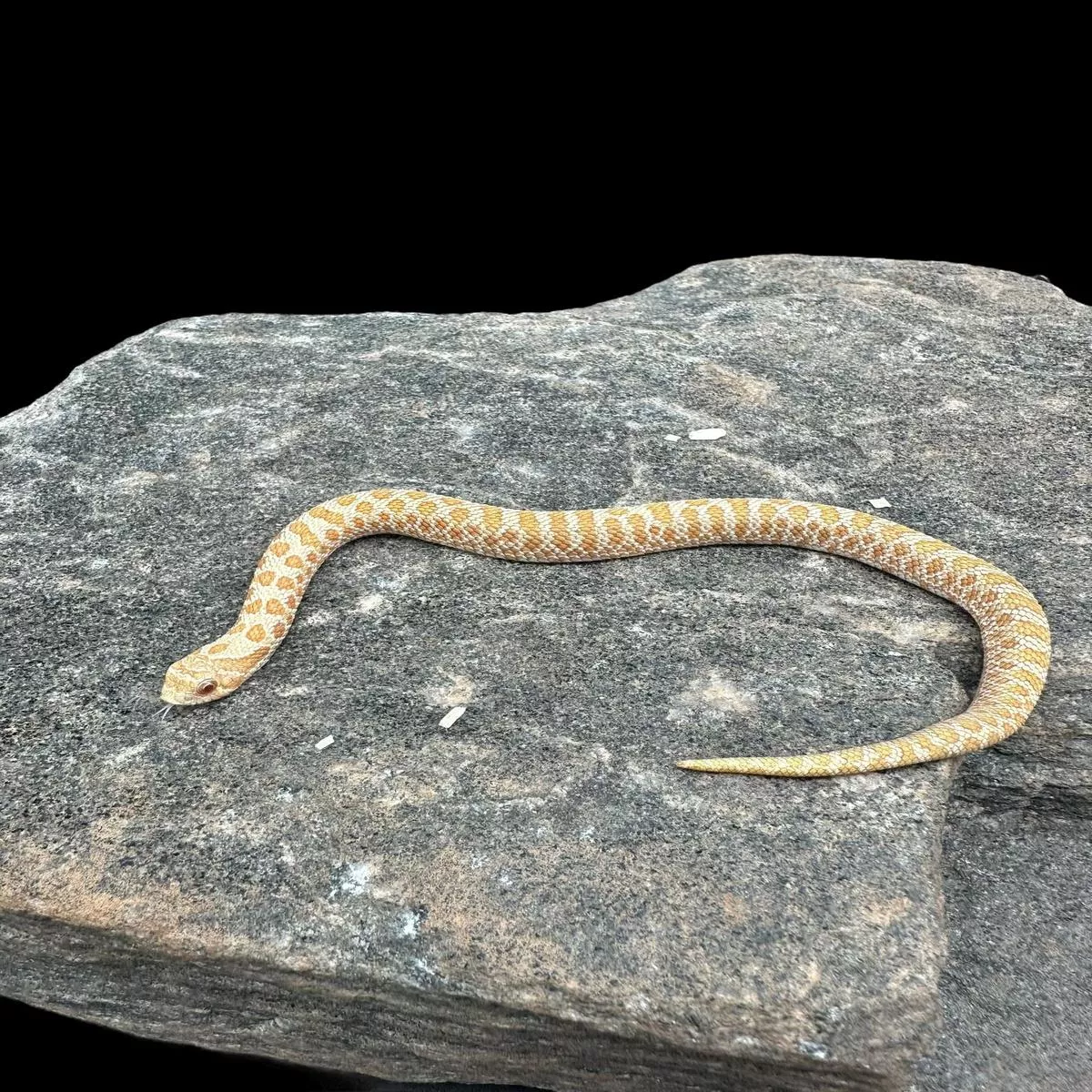
Western Hognose (Anaconda het. Sable, 50% het. Albino)
Scientific Name: Heterodon nasicusCommon Name: Western Hognose Snake
Species Overview
Size: Adult females typically reach 23 feet (0.60.9 m) in length, while males are smaller, averaging 1.52 feet (0.450.6 m). Both sexes share the characteristic upturned snout used for digging and burrowing through sandy soil.
Appearance: The Anaconda het. Sable, 50% het. Albino Western Hognose features the bold, pattern-reducing effect of the Anaconda gene combined with the hidden potential of two recessive traits. Visually, this morph displays a rich brown or tan base colour with scattered, irregular blotches that fade toward the sides, giving a clean, minimalistic appearance. The Anaconda gene simplifies the pattern, while the het. Sable gene (non-visual in this form) contributes genetic potential for darker, cooler-toned offspring. The 50% het. Albino trait means this individual may also carry the recessive Albino gene, opening the possibility for warm, gold-toned combinations when paired correctly. The overall look is smooth and well balanced, with strong breeding versatility.
Distribution: Native to central North America, ranging from southern Canada through the central United States and into northern Mexico.
Habitat: Western Hognose Snakes inhabit prairies, grasslands, and semi-arid regions with loose, sandy soil ideal for burrowing. In captivity, this morph thrives in terrestrial terrariums with soft substrate, climbing dcor, and secure hiding areas.
Behaviour: Western Hognoses are diurnal and known for their playful defensive displays, which include hissing, neck flattening, and mock striking. Despite their dramatic behaviour, they are gentle and settle quickly with consistent handling.
Captive Care
Enclosure: Provide an enclosure at least 3 feet18 inches18 inches for adults, with deep substrate for burrowing. Use aspen, soil, or a sand-soil blend. Add multiple hides, smooth dcor, and low branches for enrichment and exploration.
Temperature & Humidity: Maintain a daytime gradient of 7886F (2530C) with a basking area near 90F (32C). Allow nighttime drops to 7074F (2123C). Maintain humidity between 3050%, increasing slightly during shedding cycles.
Diet: Offer thawed rodents approximately 1.25 the width of the snakes mid-body. Feed juveniles every 45 days and adults every 710 days. Western Hognoses are strong feeders with predictable appetites.
Behaviour in Captivity: Active and inquisitive, these snakes adapt well to consistent care and regular handling. They are hardy and thrive under stable temperature and humidity conditions.
Special Considerations: Western Hognoses are mildly rear-fanged, and their venom poses minimal risk to humans unless an allergic reaction occurs. Handle calmly and confidently, and always house individuals separately to prevent feeding-related aggression or stress.
Genetics Note
Anaconda (Incomplete Dominant): Reduces and scatters the dorsal blotches, creating a cleaner, minimalistic pattern. Super Anaconda (homozygous) forms are nearly patternless.
het. Sable (Recessive Carrier): Carries one copy of the Sable gene, which deepens brown tones and darkens pigmentation when visual.
50% het. Albino (Possible Recessive Carrier): May carry one copy of the Albino gene, which removes black pigmentation and replaces it with warm yellow, orange, and cream tones when visual. The 50% het. designation indicates a one-in-two chance of carrying the gene. (Het is short for heterozygous, meaning one copy of the gene may be carried but not expressed.)
Genetic Combination Summary
The Western Hognose (Anaconda het. Sable, 50% het. Albino) expresses one visible trait and carries two possible recessive genes:
-
Anaconda (Incomplete Dominant): Produces a reduced and irregular blotched pattern, giving the body a smooth, minimalistic appearance.
-
het. Sable (Recessive Carrier): Deepens and darkens pigmentation in offspring when visual.
-
50% het. Albino (Possible Recessive Carrier): May carry the Albino gene, allowing for warm-toned or contrasting morphs when bred to compatible partners.
This combination offers strong visual appeal with significant breeding potential. The Anaconda het. Sable, 50% het. Albino Western Hognose is valued for its clean, understated look and its ability to contribute to dark, high-contrast, or Albino-based projects in future pairings.