
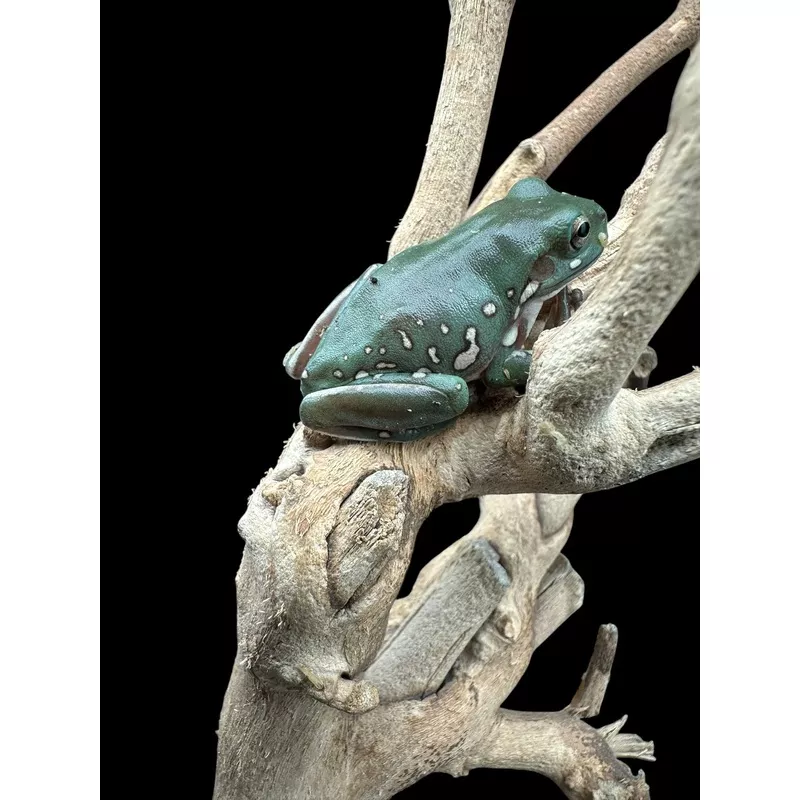
Whites Tree Frog (Snow Flake)
Scientific Name: Litoria caeruleaCommon Name: Whites Tree Frog, Snow Flake Whites Tree Frog
Species Overview
Size: Adults typically reach 3 to 4.5 inches (7.5 to 11.5 cm), with females slightly larger.
Appearance: The Snow Flake Whites Tree Frog is a selectively bred visual form known for its distinct white spotting or flecking scattered across the body. These markings may appear as small speckles, larger blotches, or a mixture of both, giving the frog a snow-dusted appearance. Base colour varies from green to blue or teal depending on the individual, with the white patterning overlaying the natural tones. The skin is thick, smooth, and waxy, and the frog retains the species characteristic rounded build, strong limbs, and large adhesive toe pads. Eyes are typically golden or bronze with horizontal pupils.
Distribution: The wild species is native to Australia, Indonesia, and Papua New Guinea. The Snow Flake variant is strictly a captive-bred trait and does not exist in wild populations.
Habitat: In the wild, Whites Tree Frogs inhabit forests, woodland edges, riparian environments, and suburban areas. They favour elevated resting sites such as tree cavities, foliage, or sheltered crevices.
Behaviour: Known for their calm and forgiving temperament, these frogs are nocturnal, becoming active at night to climb, feed, and explore. They often perch in open areas and exhibit strong feeding responses. Snow Flake individuals behave identically to the wild type in terms of activity and temperament.
Captive Care
Enclosure: A single adult or small group thrives in an 181824 inches (454560 cm) enclosure, while larger groups benefit from a 241824 inches (604560 cm) setup. Provide sturdy branches, cork rounds, vines, and broad leaves to allow climbing and secure resting places. Use a moisture-retentive but well-drained substrate such as coco fibre, soil blends, or sphagnum mixes. Include a large, shallow water basin, as these frogs commonly soak.
Temperature and Humidity:Ambient temperature: 75 to 82F (24 to 28C)Warm area: 84 to 86F (29 to 30C)Night temperature: 70 to 74F (21 to 23C)Humidity: 50 to 80%, maintained with misting and good ventilation.
Lighting: Provide low to moderate UVB (2 to 5%) with bright, diffused lighting. Snow Flake patterning tends to look most vibrant under naturalistic lighting.
Diet: Offer medium to large insects such as crickets, roaches, silkworms, black soldier fly larvae, hornworms, and occasional waxworms. Supplement insects with calcium and a multivitamin.
Behaviour in Captivity: Snow Flake Whites Tree Frogs are hardy, active, and visually engaging. They acclimate easily to planted or semi-planted enclosures. They become active at night and often perch in visible, elevated spots. Although more tolerant of interaction than most amphibians, handling should remain minimal.
Special Considerations: Handle only with wet, powder-free gloves to protect their sensitive skin. Ensure good ventilation to prevent respiratory issues. Avoid keeping the substrate constantly saturated; allow natural humidity cycles. Provide sturdy dcor, as these frogs are heavy-bodied climbers. Use only dechlorinated or RO water for soaking and misting. Monitor diet closelythis species is prone to obesity in captivity.
Taxonomy Note
Litoria caerulea is part of the family Pelodryadidae and is closely related to other Australian and New Guinean tree frogs. Its adaptability, robust build, and gentle nature make it one of the most popular amphibian species in captivity.
Genetics Note
Snow Flake (line-bred trait):This visually distinctive trait produces irregular white spotting or flecking across the frogs body. The intensity and distribution of the white pattern vary among individuals. The Snow Flake trait is not associated with a single identified gene and instead results from multigenerational selective breeding aimed at amplifying naturally occurring white speckling in Ranoidea caerulea.






 No products in the cart.